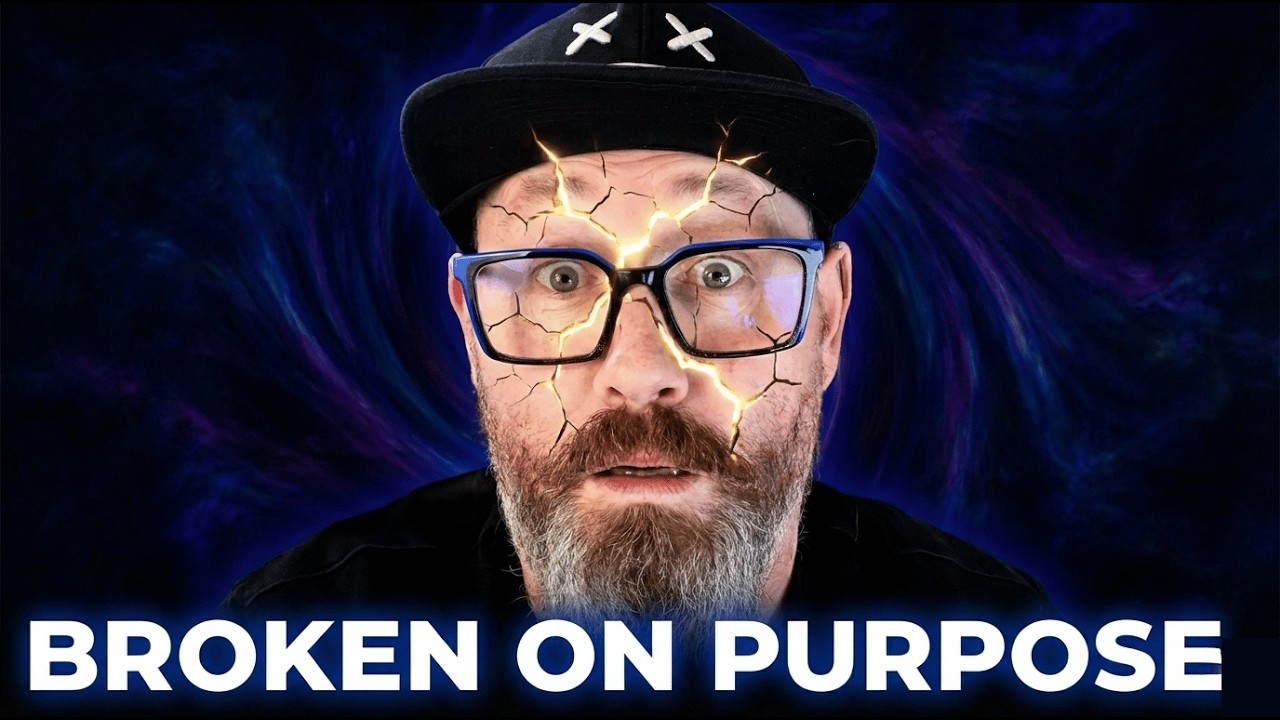
What Is Positive Disintegration? Dąbrowski's Theory of Falling Apart on Purpose
There is a theory that says falling apart is not the problem. That the problem is having been held together by forces that were never yours. It belongs to a Polish psychiatrist named Kazimierz Dąbrowski, and it carries a name most people mishear the first time: positive disintegration. As in, the destruction of a functioning personality might be the only evidence that a real one is trying to form.
Dąbrowski first outlined the theory in his 1964 book Positive Disintegration, then developed it across several subsequent works including Personality-shaping Through Positive Disintegration (1967) and Psychoneurosis Is Not an Illness (1972). He was writing against the prevailing psychiatric consensus of his time, which treated inner conflict, anxiety, and psychological disturbance as symptoms to be corrected. Dąbrowski's position was that in certain people, under certain conditions, those disturbances were not signs of illness but of a personality attempting to reorganise itself at a higher level. The psychiatric establishment was not enthusiastic about this.
Most available explanations of positive disintegration get it wrong in the way that matters most: they make it safe. They arrange Dąbrowski's five levels into a staircase and imply the reader is climbing it. They repackage a theory born in the clinical observation of suicidal adolescents and the wreckage of two world wars into a personal development framework. Dąbrowski was not offering a programme for self-improvement. He was describing what happens when the self can no longer hold its own shape, and why that collapse is not always the catastrophe it appears to be. Those are different projects, and the distance between them is where most of the misunderstanding lives.
What Is Dąbrowski's Theory of Positive Disintegration?
The theory of positive disintegration (TPD) is a theory of personality development, though the word "development" risks making it sound gentler than it is. What Dąbrowski proposed was that the personality most people carry through life is not truly a personality. It is an arrangement assembled from biological impulse and social conditioning, held in place by the simple fact that it has never been seriously questioned. He called this state primary integration: functional, adjusted, unremarkable. The kind of psychological configuration that can sustain a career, a marriage, a life, without ever requiring the person inside it to ask whether the life being lived was chosen or merely inherited.
Positive disintegration is what happens when that arrangement begins to fail from the inside. The failure does not always come from external catastrophe, though catastrophe can trigger it. It comes from something in the person's own psychological constitution that will not stay settled. An anxiety that outpaces its circumstances. A dissatisfaction that refuses to attach itself to anything fixable, because the problem is not situational. The problem is the self that is doing the living. Dąbrowski argued that these states, which conventional psychiatry would classify as disorders, might be signs that the psyche is attempting to restructure itself. The disintegration is positive because it has developmental direction. But the word "positive" does more harm than good if it implies the process is pleasant, predictable, or guaranteed to succeed. It is none of those things.
The Five Levels of Positive Disintegration
Dąbrowski described five levels of development. They are not stages. This distinction matters because the stage model implies sequential progression and universal applicability. TPD implies neither. Most people never leave Level I. Many who begin to disintegrate never move beyond Level II. The theory describes what is possible for some people under specific conditions, not what is inevitable or even likely.
Level I: Primary Integration.
Identity at this level is constructed from available materials: social expectation, biological drive, cultural script. There is no inner conflict because there is no inner hierarchy, no felt distinction between higher and lower impulses or values. The question "is this who I really am?" does not arise, not because the person lacks depth but because the psychological architecture that would generate such a question has not yet been built. Dąbrowski did not treat Level I as a moral failing. He noted that people at primary integration can be stable, kind, and productive. They can also be ruthless. What defines Level I is not character but the absence of internal friction between competing values. The engine runs. Nobody has checked what it runs on.
Level II: Unilevel Disintegration.
The first real disruption, and the most dangerous. The identity begins to fragment, but the fragments carry no directional information. Every alternative appears equivalent. The person oscillates between positions that all sit at the same psychological altitude, with no felt sense of higher or lower to orient by. This is what Dąbrowski meant by "unilevel": horizontal crisis, motion without movement. It is the level where conventional self-help fails most completely, because self-help presupposes that the person knows what "better" means and just needs assistance getting there. At Level II, "better" has no referent. Dąbrowski was explicit that people can remain here indefinitely. People can die here. He was not speaking metaphorically.
Level III: Spontaneous Multilevel Disintegration.
The crisis acquires a vertical dimension. The person begins to perceive, not as an intellectual exercise but as a felt experience in the body, a hierarchy within their own psychological structure. Some impulses, values, and ways of being are recognised as closer to what the person could become. Others are recognised as further away. The distance between those two positions is experienced as a new and specific kind of suffering. This is where Dąbrowski's dynamisms emerge: astonishment with oneself, disquietude with oneself, dissatisfaction with oneself, feelings of shame and guilt that attach not to any single act but to the entire shape of a life lived without examination. These dynamisms are not symptoms to be alleviated. In Dąbrowski's framework, they are the developmental mechanism itself. The personality is sorting itself into higher and lower, and the sorting is as violent as it sounds.
Level IV: Organised Multilevel Disintegration.
The reorganisation becomes deliberate. The person moves from experiencing the inner hierarchy to actively constructing within it, choosing what to retain and what to discard based on an internal standard Dąbrowski called the personality ideal. This is not a destination. It is still disintegration, still ongoing construction while the ground shifts. What has changed is that the process has become conscious and self-directed. The person is no longer at the mercy of their own development. They are participating in it. This level shares uncomfortable surface similarities with what self-help culture promises: intentional self-construction, values-based living, conscious choice. The difference is that Dąbrowski's version is built on the wreckage of everything that came before it, and the wreckage has not been cleared away. It is the foundation.
Level V: Secondary Integration.
The theoretical endpoint: a new personality integration organised around the values and commitments that survived the disintegration process. Dąbrowski pointed to figures like Gandhi and Dag Hammarskjöld as possible exemplars, but he hedged. Whether Level V represents a fully achievable psychological state or a directional principle that gives the developmental process its orientation is a question the theory leaves open. Dąbrowski's own writing suggests he considered it asymptotic: something you move toward, not something you reach. The honest reading is that Level V functions as the coordinate that makes the other levels meaningful, the reason the disintegration can be called positive at all.

Developmental Potential: Why Some People Disintegrate and Others Don't
Dąbrowski did not believe everyone was equally equipped for personality development. He introduced the concept of developmental potential: the combination of factors that determines whether a given person's disintegration leads to reorganisation or simply to destruction.
The first factor is constitutional, and its most distinctive component is what Dąbrowski called overexcitability (OE): innate, heightened responsiveness across five domains. Psychomotor OE is a surplus of physical and nervous energy. Sensual OE is an intensity of sensory experience that makes the texture of the world sharper and more abrasive. Intellectual OE is the compulsion to question, to analyse, to refuse answers that do not satisfy. Imaginational OE is the capacity to generate rich inner worlds and possibilities beyond the given. Emotional OE is a depth and range of feeling that makes ordinary experience arrive at an intensity most people do not register. These overexcitabilities are not gifts in any simple sense. They are the neurological substrate that makes disintegration possible: the reason certain people cannot rest inside the accepted version of reality.
The second factor is environmental: the external conditions of a person's development. Dąbrowski acknowledged its importance but gave it less weight than most developmental psychologists. A supportive environment can protect the process. A hostile one can crush it. But environment alone cannot generate development.
The third factor is the most radical element of the theory. Dąbrowski called it, with characteristic plainness, the third factor: an autonomous, internal force that drives the person toward their own development. It is not reducible to biology or conditioning. It arises from within and refuses the current arrangement of the self. Where does it come from? Dąbrowski could observe its presence and its absence but could not fully account for its origins. The third factor is what separates disintegration that reorganises from disintegration that merely destroys, and it remains the theory's most powerful claim and its most contested.
Positive Disintegration Is Not Self-Help
The popular version of Dąbrowski's theory tells people their suffering is meaningful, their crisis is development, their falling apart is the prelude to a higher self. There is enough truth in that to make it seductive, and the seduction is precisely the problem.
Dąbrowski was saying that disintegration can be positive. He was not saying it will be. He estimated that roughly 35 per cent of the population possesses the developmental potential for multilevel disintegration. The remaining 65 per cent will live at Level I, not because they failed at self-examination but because they are constitutionally configured for a different kind of psychological life. The theory does not moralise about this. It reports it with the clinical directness of a man who had watched whole populations respond to civilisational collapse in radically different ways and did not pretend the differences were trivial.
And even among those who begin to disintegrate, the outcome is not assured. Dąbrowski worked with people in genuine psychic freefall. He titled a book Psychoneurosis Is Not an Illness, which sounds like a slogan until you understand the clinical courage it required: a practising psychiatrist insisting that the anxiety and depression his colleagues were trying to eliminate might be evidence of a personality trying to develop. He was not naive about what that development could cost. He knew that a mind tearing itself apart does not always find a better configuration. Some people fall and do not reassemble. The theory holds both outcomes without choosing between them, and any interpretation that presents only the hopeful one is not explaining Dąbrowski. It is selling him.

Why Positive Disintegration Matters Now
Dąbrowski built this theory in a Poland that had been invaded, occupied, and restructured multiple times within his lifetime. He was arrested by the Gestapo. He later faced persecution under the Soviet-aligned government. He watched the social and psychological infrastructure of his world disappear and be rebuilt and disappear again, and he observed that the human response was not uniform. Some people collapsed and stayed collapsed. Some collapsed and, over time, reassembled into something their previous selves could not have produced. The difference was not willpower or positive thinking. It was structural, constitutional, and it could be described but not prescribed.
The relevance of the theory of positive disintegration now is not simply that conditions are difficult. It is that the structures most people use to construct and maintain a coherent identity are eroding in ways that look, from a Dąbrowskian perspective, like the conditions for unilevel disintegration at a civilisational scale. The cultural and institutional scripts that once provided the scaffolding for stable primary integration, religious belonging, vocational identity, community embeddedness, coherent national narratives, are losing their binding force. What fills the gap resembles what Dąbrowski described at Level II: crisis without direction, fragmentation without hierarchy, the sense that something is wrong in a way that has no name and no available remedy because the wrongness is not personal. It is structural.
The theory does not fix that. It does not offer practices or programmes or steps toward reintegration. What it offers is a framework for understanding why the falling apart happens, what it might indicate about the person experiencing it, and why the reflexive impulse to make it stop, to medicate the discomfort or reframe it as a phase, might be the least useful response available. Dąbrowski did not promise that understanding would be enough. He did not promise anything. He described a territory that most psychology would prefer to medicate out of existence, and he insisted that the territory was real and that some of the people lost in it were not lost at all.
Whether that is enough depends on what you are looking for. If you want a theory that tells you what to do with the wreckage, this is the wrong place. If you want a theory that refuses to pretend the wreckage is not there, Dąbrowski left one, and most of the world still hasn't caught up to it.